
5+ Phong Cách Lam Che Nắng Xi Măng Giả Gỗ Ngoài Trời Nên Lựa Chọn 2026 √ Nắng nóng gay gắt ở Việt...
Read More
SHERA Wood là gì ? Có bao nhiêu chủng loại & ứng dụng trong xây dựng, lắp đặt
Trong xu thế kiến trúc hiện đại, sự lên ngôi của các vật liệu xanh, thân thiện với môi trường ngày càng rõ nét. Trong bối cảnh nguồn tài nguyên gỗ tự nhiên ngày càng khan hiếm, giữa bối cảnh đó, tấm xi măng vân gỗ nổi lên như một lựa chọn tối ưu, đáp ứng nhu cầu về tính thẩm mỹ, độ bền vững và sự an toàn cho sức khỏe.
Vật liệu này không chỉ mang đến vẻ đẹp tự nhiên, ấm cúng của gỗ mà còn khắc phục được những nhược điểm cố hữu của gỗ tự nhiên, mở ra xu hướng mới trong thiết kế và thi công nội ngoại thất. Sau đây chúng ta cùng tìm hiểu một dòng sản phẩm tấm xi măng vân gỗ mang tên SHERA Wood qua bài viết chi tiết dưới đây:
I. SHERA Wood là gì?
SHERA Wood là tên thương hiệu để phân biệt giữa tấm xi măng giả gỗ “dạng thanh” và tấm Cemboard “dạng tấm” của một loại vật liệu xây dựng được sản xuất bởi Tập đoàn Mahaphant (Thái Lan). Về cơ bản, SHERA Wood là tấm xi măng giả gỗ, được làm từ hỗn hợp xi măng Portland, sợi cellulose và cát siêu mịn, phụ gia khác,…
Đặc biệt, SHERA Wood là sản phẩm không chứa chất Ami-ăng, an toàn sức khỏe cho người sử dụng & thân thiện với môi trường.

II. Đặc tính nổi bật của tấm xi măng giả gỗ SHERA Wood
1. Thành phần cấu tạo an toàn, thân thiện với môi trường
SHERA Wood là sản phẩm được sản xuất bằng công nghệ Auto Clave Flow On được xử lý với nhiệt độ và áp suất cao giúp hỗn hợp xi măng Portland, sợi Xenlulo (sợi gỗ), cát mịn Oxit Silic & một số phụ gia khác liên kết chặt chẽ với nhau, tạo thành sản phẩm có độ bền cao.
Không chứa chất Ami-ăng: Đây là điểm cộng lớn so với một số tấm xi măng thường khác, sản phẩm đảm bảo sức khỏe cho người sử dụng
2. Độ bền cao:
Khả năng chịu lực tốt: Kết cấu vững chắc từ xi măng Portland và sợi xenlulo giúp tấm xi măng giả gỗ SHERA Wood có khả năng chịu lực cao, chống va đập mạnh, phù hợp với nhiều ứng dụng khác nhau.
Chống mối mọt, côn trùng: Bản chất tấm xi măng giả gỗ SHERA Wood có cấu tạo từ xi măng, nên các loại côn trùng gây hại thường gặp ở gỗ tự nhiên như mối mọt, côn trùng đều “miễn dịch”
3. Kích thước đa dang, linh hoạt:
Tấm xi măng giả gỗ SHERA Wood với đa dạng kích thước, chủ yếu dạng thanh nên việc thi công, khuân vác tại các công trình, vị trí có địa hình khó trở nên dễ dàng.
Đặc biệt, được xử lý qua công nghệ Roll Forming kết hợp với công nghệ nồi hấp Auto Clave Flow On, sản phẩm không bị co ngót, cong vênh hay giãn nỡ do tác động của thời tiết. Đảm bảo tính thẫm mỹ lâu dài cho công trình.
4. Chống ẩm, chống nước & chống cháy:
Thành phần xi măng giúp tấm xi măng vân gỗ SHERA Wood có khả năng chống thấm nước tốt, hạn chế sự ảnh hưởng của độ ẩm, phù hợp với khí hậu nhiệt đới gió mùa tại Việt Nam. Hơn nữa, lựa chọn các vật liệu có khả năng chống cháy cũng đang là ưu tiên hàng đầu cho công trình.
III. Phân loại tấm xi măng giả gỗ SHERA Wood & Ứng dụng trong xây dựng, lắp đặt.
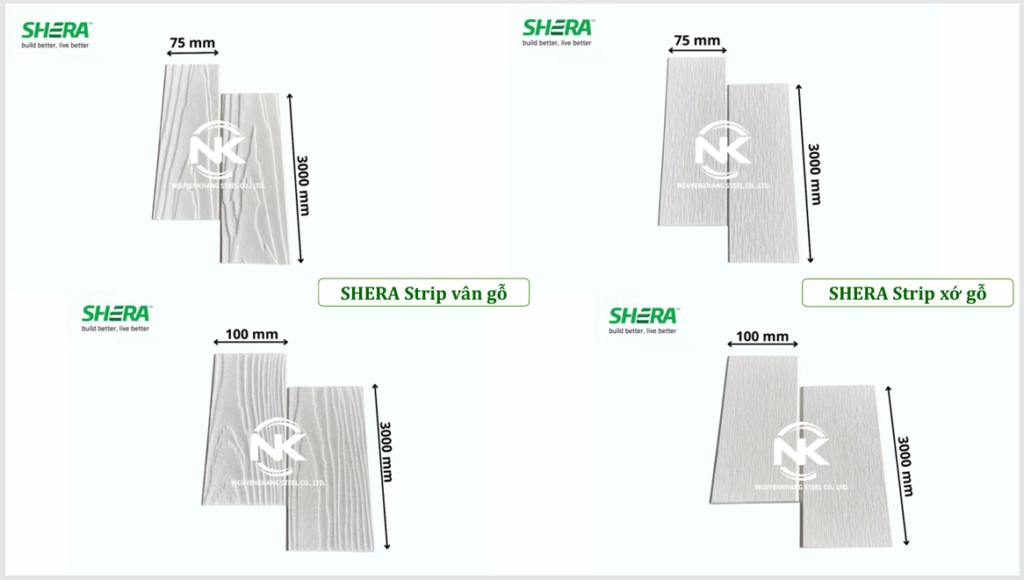
1. SHERA Strip: Ốp trần, ốp trần mái hiên, lam che nắng, hàng rào
Bảng kích thước và trọng lượng của dòng tấm xi măng giả gỗ SHERA Strip
| Sản phẩm | Kích thước (mm) | Trọng lượng (kg) | Thanh/m2 |
| Vân gỗ (Teak), Sớ gỗ (Straight), vuông cạnh | 8 x 75 x 3000 | 2.7 | 4.45 |
| Vân gỗ (Teak), Sớ gỗ (Straight), vát cạnh | 8 x 100 x3000 | 3.6 | 3.34 |
Hình ảnh: Mẫu tấm SHERA Wood dòng (SHERA Strip), vát cạnh (V) với độ dày 75x3000x8mm & 100x3000x8mm
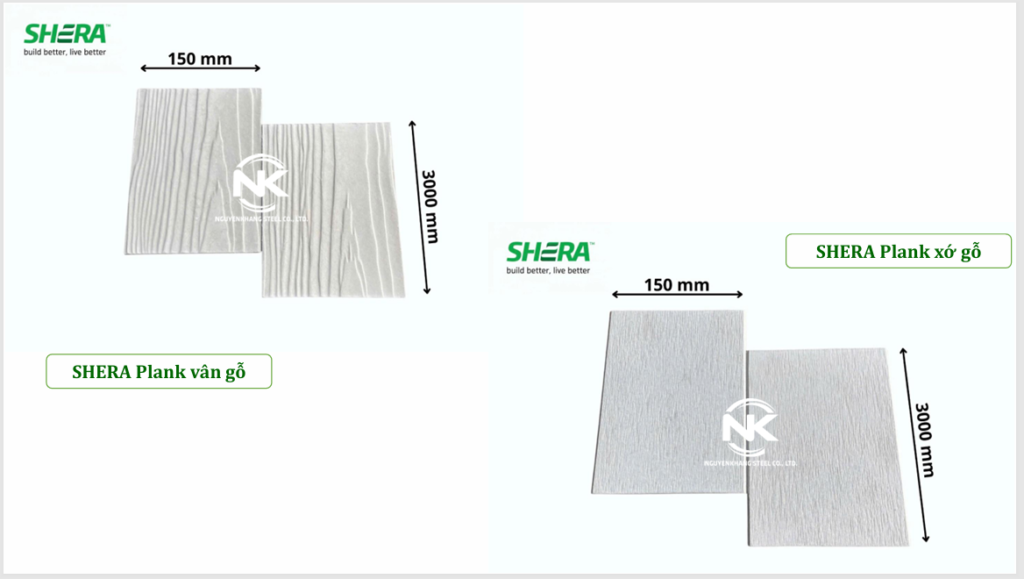
2. SHERA Plank: Ốp tường nội ngoại thất
Bảng kích thước và trọng lượng của dòng tấm xi măng giả gỗ SHERA Plank
| Sản phẩm | Kích thước (mm) | Trọng lượng (kg) | Thanh/m2 |
| Vân gỗ (Teak), vuông cạnh | 8 x 150 x 3000 | 5.4 | 2.67 |
| Vân gỗ (Teak), vuông cạnh | 8 x 200 x 3000 | 7.2 | 2.00 |
| Vân gỗ (Cassia), vuông cạnh | 8 x 150 x 4000 | 7.2 | 2.00 |
| Vân gỗ (Cassia), vuông cạnh | 8 x 200 x 4000 | 9.6 | 1.50 |
Hình ảnh: Mẫu tấm SHERA Wood dòng (SHERA Plank), vuông cạnh với độ dày 150x3000x8mm
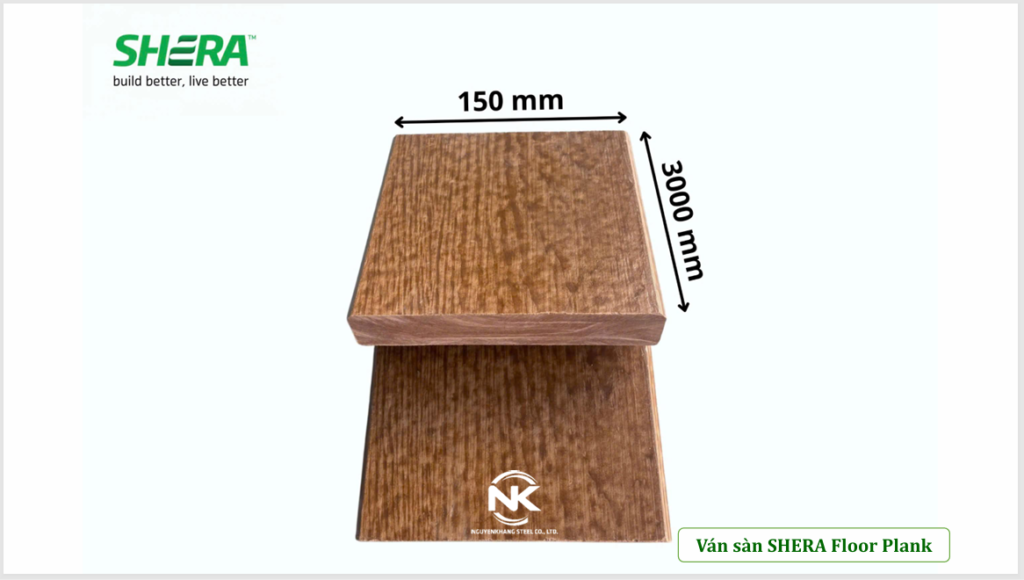
3. Ván sàn SHERA Floor Plank: Ốp sàn nội ngoại thất
Bảng kích thước và trọng lượng của dòng tấm xi măng giả gỗ SHERA Floor Plank
| Sản phẩm | Kích thước (mm) | Trọng lượng (kg) | Thanh/m2 |
| SHERA Floor Plank vân cassia, vát cạnh | 25 x 150 x 3000 | 17.75 | 2.22 |
| SHERA Floor Plank vân cassia, vát cạnh | 25 x 200 x 3000 | 23.67 | 1.67 |
Hình ảnh: Mẫu tấm SHERA Wood dòng (SHERA Floor Plank), vuông cạnh với độ dày 150x3000x25mm
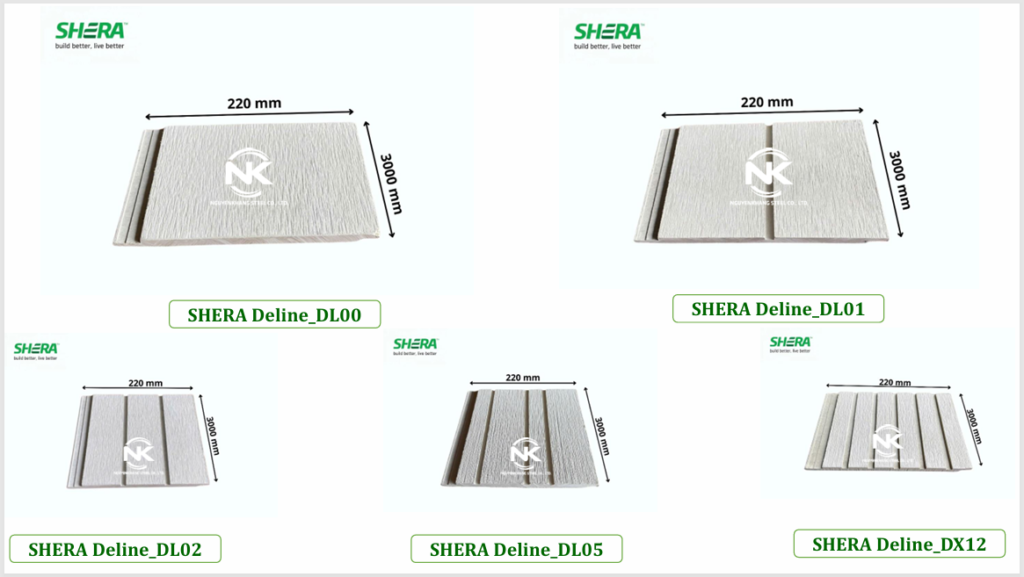
4. SHERA Deline hèm âm dương: Ốp tường nội ngoại thất
Bảng kích thước và trọng lượng của dòng tấm xi măng giả gỗ SHERA Deline
| Kiểu rãnh | Kích cỡ (mm) | Khối lượng (kg) | Thanh/m2 |
| SHERA Deline DL00, Xớ gỗ (Straight) | 10 x 220 x 3000 | 8,93 | 1.64 |
| SHERA Deline DL01, Xớ gỗ (Straight) | 10 x 220 x 3000 | 8,77 | 1.64 |
| SHERA Deline DL02, Xớ gỗ (Straight) | 10 x 220 x 3000 | 8,60 | 1.64 |
| SHERA Deline DL05, Xớ gỗ (Straight) | 10 x 220 x 3000 | 8.12 | 1.64 |
| SHERA Deline DX12, Xớ gỗ (Straight) | 10 x 220 x 3000 | 8,44 | 1.64 |
Hình ảnh: Mẫu tấm SHERA Wood dòng (SHERA Deline) với độ dày 220x3000x10mm
5. SHERA vân gỗ hèm khóa: Ốp tường ngoại thất
Bảng kích thước và trọng lượng của dòng tấm xi măng giả gỗ SHERA vân gỗ hèm khóa
| Sản phẩm | Kích thước (mm) | Trọng lượng (kg) | Thanh/m2 |
| Vân gỗ (Cassia) hèm khóa | 10 x 150 x 3000 | 5.77 | 2.57 |
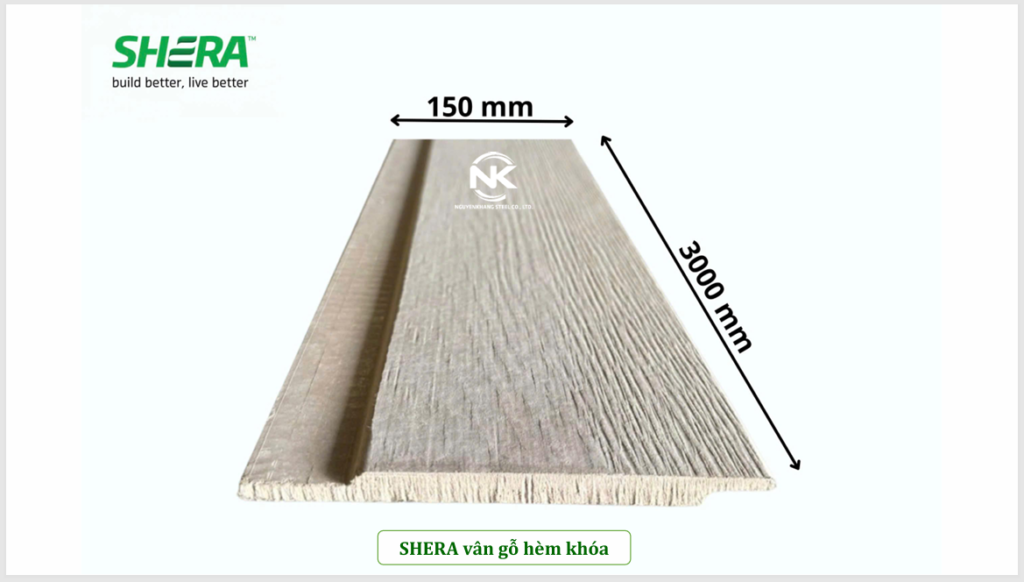
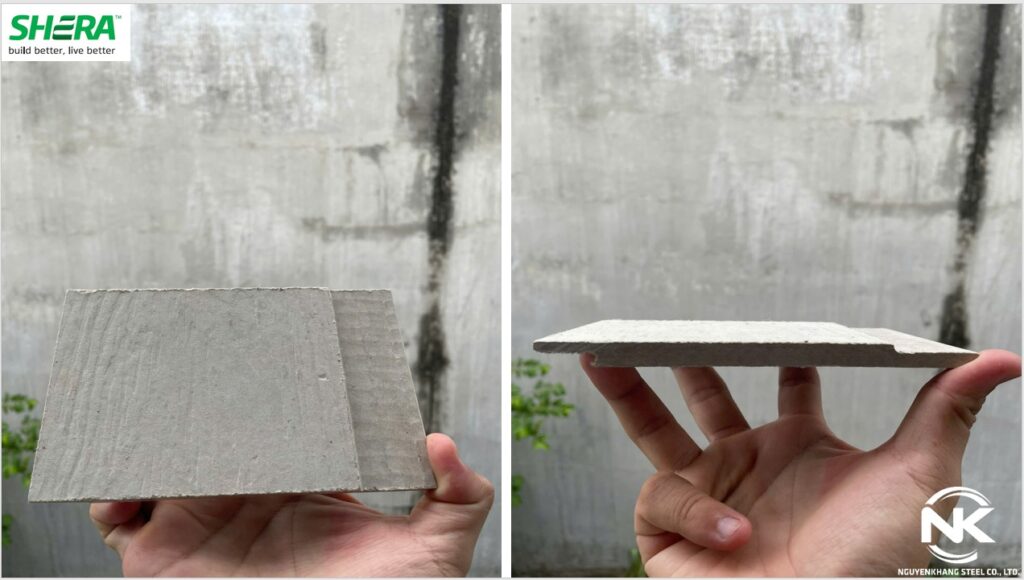
Hình ảnh: Mẫu tấm SHERA Wood dòng (SHERA Splendid Plank Cassia), với độ dày 150x3000x10mm
Qua bài viết trên, chúng ta đúng kết lại những băn khoăn & mở ra sự lựa chọn:
SHERA Wood của thương hiệu SHERA thuộc tập đoàn Mahaphant (Thái Lan) đã thành công giải quyết những bài toán nan giải mà các vật liệu như gỗ tự nhiên hay gỗ công nghiệp thường gặp phải. Những vấn đề về mối mọt, cong vênh, ẩm mốc nay đã được thay thế bằng sự an tâm tuyệt đối với khả năng chống chịu thời tiết vượt trội của SHERA Wood.
Không chỉ dừng lại ở độ bền so với các vật liệu cùng ứng dụng, các sản phẩm của SHERA Wood còn chinh phục người dùng bởi vẻ đẹp tinh tế, sang trọng. Vân gỗ tự nhiên chân thực cùng bảng màu đa dạng mở ra không gian sáng tạo cho các kiến trúc sư và các nhà thi công chuyên nghiệp,…
Hơn nữa, hướng tới tương lại vật liệu xanh: Với những ưu điểm vượt trội, SHERA Wood đang dần khẳng định vị thế dẫn đầu trong ngành vật liệu xây dựng. Sự tin tưởng và lựa chọn của người tiêu dùng chính là động lực để SHERA tiếp tục nghiên cứu, phát triển và hoàn thiện, mang đến những sản phẩm chất lượng, góp phần kiến tạo nên một tương lai xanh và bền vững cho ngành xây dựng.
VPN Technology in Gaming: Betzoid Australia’s Technical Overview
Virtual Private Network technology has fundamentally transformed the gaming landscape, creating new possibilities for players while introducing complex technical considerations. As gaming platforms increasingly operate across global networks, VPN integration has become essential for maintaining security, accessing geo-restricted content, and ensuring optimal performance. This technological evolution represents a significant shift in how gaming services approach network infrastructure and user accessibility.
Evolution of VPN Implementation in Gaming Platforms
The integration of VPN technology into gaming platforms began in the early 2000s as online gaming expanded beyond local networks. Initially, VPNs served primarily as tools for corporate remote access, but gaming companies recognized their potential for addressing latency issues and regional restrictions. The first major implementations focused on creating secure tunnels between players and game servers, reducing packet loss and improving connection stability.
By 2010, sophisticated gaming platforms began developing proprietary VPN solutions tailored specifically for gaming traffic. These systems prioritized low-latency protocols and optimized routing algorithms to minimize the traditional speed penalties associated with VPN usage. The technology evolved from simple encryption tunnels to intelligent network management systems capable of dynamically selecting optimal server routes based on real-time performance metrics.
Modern gaming VPN implementations utilize advanced protocols such as WireGuard and IKEv2, which offer superior performance compared to older OpenVPN standards. These protocols reduce encryption overhead while maintaining security standards, addressing the gaming industry’s unique requirement for speed without compromising data protection. The development of UDP-based protocols specifically for gaming traffic has further enhanced performance, reducing connection establishment times from seconds to milliseconds.
Technical Architecture and Performance Optimization
Contemporary VPN systems in gaming employ multi-layered architectures designed to handle diverse technical requirements. The core infrastructure typically consists of globally distributed server networks with specialized gaming nodes that prioritize traffic based on application type. These systems implement Quality of Service protocols that automatically allocate bandwidth resources to ensure consistent gaming performance even during peak usage periods.
Load balancing algorithms play a crucial role in maintaining optimal performance across VPN networks. Advanced implementations use machine learning models to predict traffic patterns and preemptively distribute loads across server clusters. This predictive approach significantly reduces the likelihood of connection drops during critical gaming moments, particularly important for competitive gaming environments where millisecond delays can determine outcomes.
Gaming platforms like those detailed at https://betzoid.com/au/vpn-friendly/ demonstrate how modern VPN integration can enhance user experience while maintaining technical excellence. These implementations showcase sophisticated traffic management systems that distinguish between different types of gaming data, applying appropriate compression and routing strategies for each category.
Encryption protocols have been specifically optimized for gaming applications, with many platforms implementing lightweight ciphers that provide adequate security without excessive computational overhead. The ChaCha20-Poly1305 cipher suite has gained popularity in gaming VPN implementations due to its efficiency on mobile processors and reduced battery consumption on portable gaming devices.
Security Framework and Data Protection
Security considerations in gaming VPN implementations extend beyond traditional data encryption to encompass anti-cheat systems, DDoS protection, and privacy preservation. Modern gaming VPNs implement zero-knowledge architectures where service providers cannot access user gaming data or connection logs, ensuring player privacy while maintaining service quality.
Advanced threat detection systems monitor VPN traffic for suspicious patterns that might indicate cheating, account sharing, or other violations of gaming platform policies. These systems use behavioral analysis algorithms to identify anomalous connection patterns without compromising user privacy, striking a balance between security and user experience.
The implementation of Perfect Forward Secrecy in gaming VPNs ensures that even if encryption keys are compromised, historical gaming sessions remain secure. This feature has become particularly important as gaming platforms store increasing amounts of user data, including payment information, gaming statistics, and social connections.
Network segmentation within VPN infrastructures isolates gaming traffic from other applications, reducing the attack surface and improving overall security posture. This approach also enables more granular traffic shaping policies that can prioritize gaming packets over less time-sensitive data transfers.
Regional Accessibility and Compliance Challenges
Gaming VPN technology faces complex regulatory landscapes across different jurisdictions, requiring sophisticated compliance frameworks that adapt to local requirements while maintaining global service consistency. The implementation of region-specific server clusters allows gaming platforms to comply with data localization requirements while providing users with optimal connection performance.
Geo-blocking circumvention capabilities built into gaming VPNs must navigate the delicate balance between user accessibility and content licensing agreements. Advanced implementations use intelligent routing that respects legitimate geographical restrictions while enabling access to globally available content, reducing legal risks for both platforms and users.
The technical challenge of maintaining consistent user experiences across regions with varying internet infrastructure has driven innovations in adaptive streaming and dynamic quality adjustment. Gaming VPNs now incorporate real-time network assessment tools that automatically adjust connection parameters based on local network conditions, ensuring optimal performance regardless of geographical location.
Compliance with emerging privacy regulations such as GDPR and CCPA has necessitated the development of privacy-by-design VPN architectures that minimize data collection while maintaining necessary functionality for gaming services. These systems implement sophisticated anonymization techniques that preserve user privacy without compromising security or performance monitoring capabilities.
VPN technology in gaming represents a sophisticated convergence of security, performance, and accessibility requirements that continues to evolve with technological advancement. The integration of machine learning, advanced encryption protocols, and intelligent traffic management has created gaming VPN solutions that enhance rather than hinder the user experience. As gaming platforms expand globally and regulatory frameworks become more complex, VPN technology will remain essential for delivering secure, accessible, and high-performance gaming experiences across diverse markets and technical environments.